The shift
How product teams will operate when AI does the building.
When delivery stops being the constraint, the upstream work needs its own infrastructure. This is what that looks like.
Teams get problems to solve, not features to build.
- Problem
- Most product orgs hand engineers feature tickets. The roadmap is a list of things to build, not outcomes to deliver, and the team's job becomes throughput on someone else's brief. When AI takes the building work, that model collapses. The unique human contribution moves upstream, to figuring out what would actually work. Feature-list roadmaps don't generate that judgment. They suppress it.
- Solution
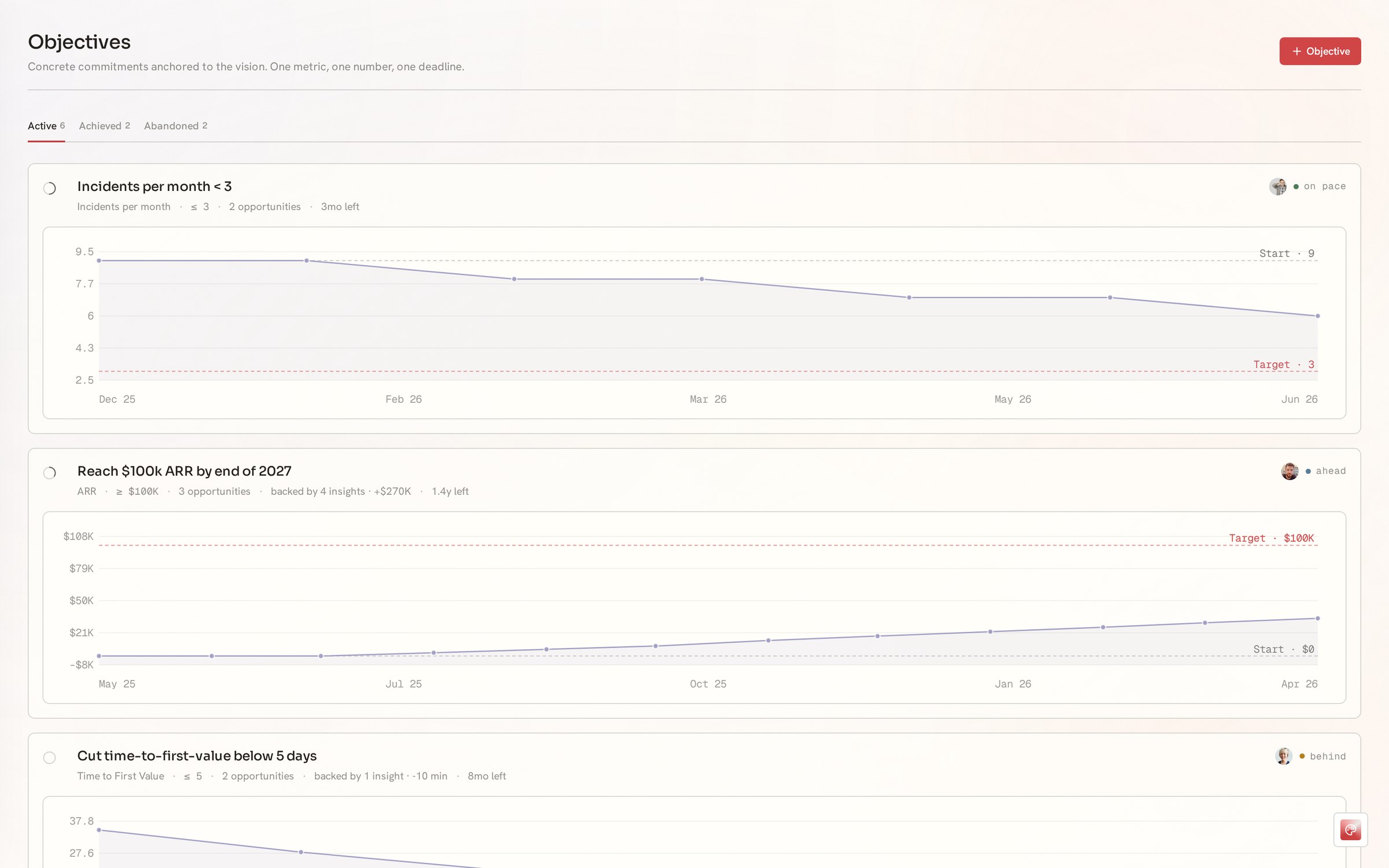
- Leadership commits to Objectives, each anchored to the Metric the org has signed up to move. Teams own the discovery: which Opportunities to attack the Objective with, which to reject, which evidence supports each bet. The roadmap isn't a list of features. It's the outcomes the company chose, and the bets the teams are running to move them.
Product discovery as a first-class template.
- Problem
- When building is fast and cheap, discovery and deciding become the rate-limiting step. With AI, teams can now fully build and ship a solution before realizing it doesn't solve the customer's actual problem faster than ever before.
- Solution
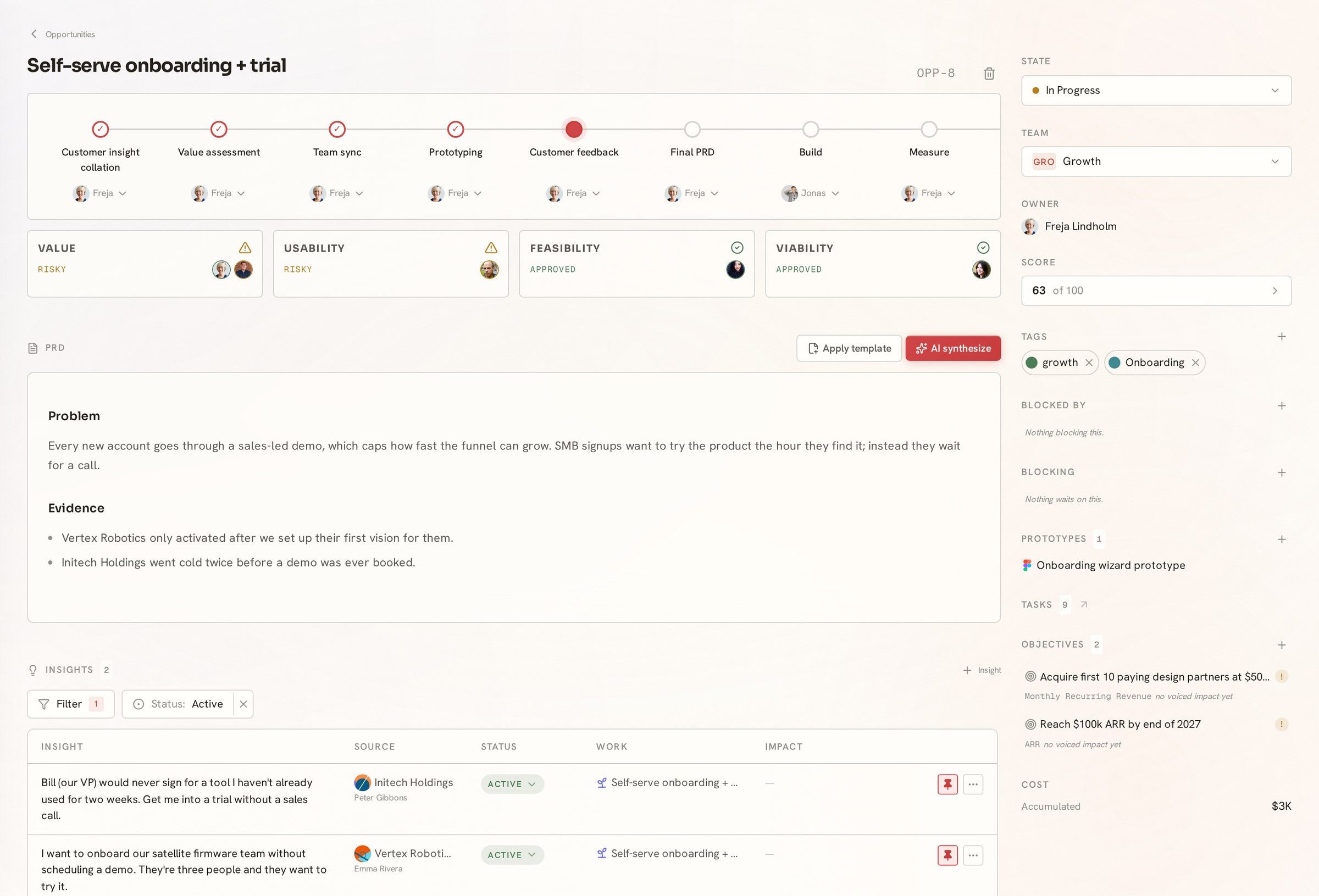
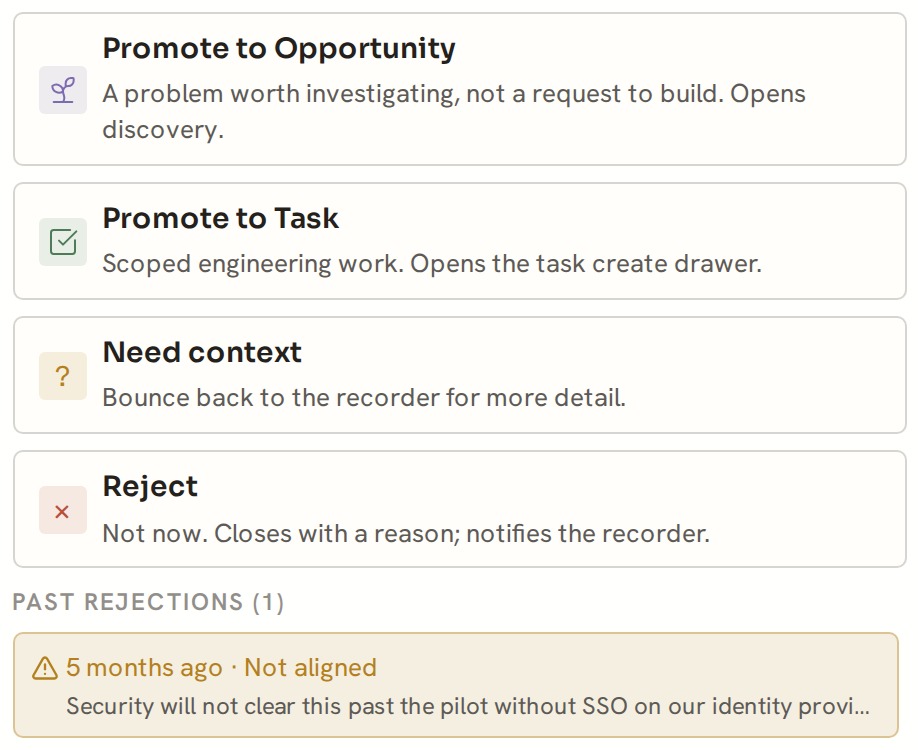
- Telos structures discovery as a template your team configures. The four product risks are fixed checkpoints every Opportunity goes through. You can move to delivery with risks flagged. The tool never blocks you. What changes is that the call is now explicit: visible, owned, not stored in someone's head. Invisible friction that nudges the hard questions before the build, and keeps the feedback loop with customers fast.
Every insight tied to the voice that raised it. Evidence as a primary asset.
- Problem
- Build verbatim for the loudest customer and you miss the pattern. Eight others asked for something related, three with dates you already committed to. The signal is there. It's buried across calls, docs, and notes nobody re-reads.
- Solution
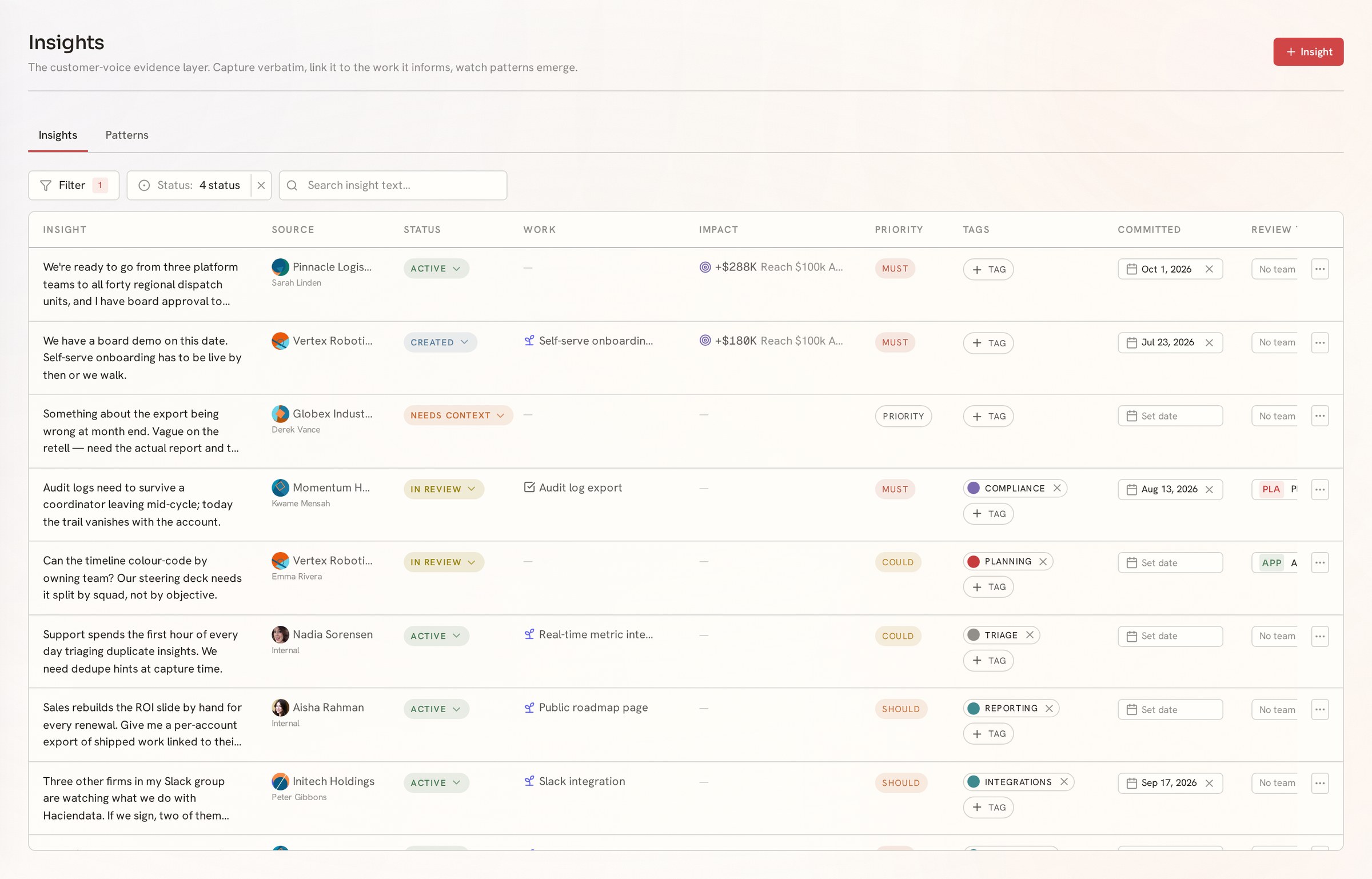
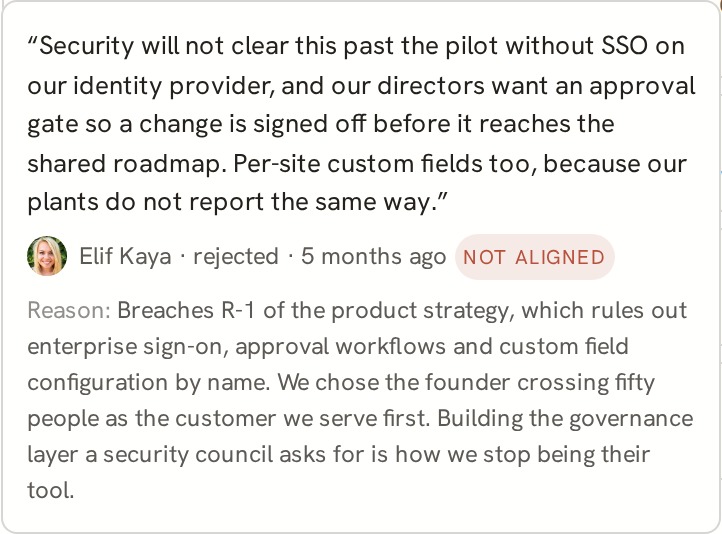
- Customers are first-class entities. Each Insight is captured verbatim against the customer or stakeholder who raised it, with any priority and any date you committed to them. Read across Insights to surface patterns your backlog cannot show. The agent flags when a request matches something the team already evaluated and rejected, and why. Every commitment is tracked, visible at planning time, and factored in when priorities shift.
An agent that has read everything your org has decided.
- Problem
- Every product decision arrives with local context: the customer who asked, the urgency of the moment, the engineer ready to build. What it doesn't arrive with is what your org already knows. The strategy it conflicts with. The Opportunity you rejected six months ago for exactly this reason. The Objective it won't move.
- Solution
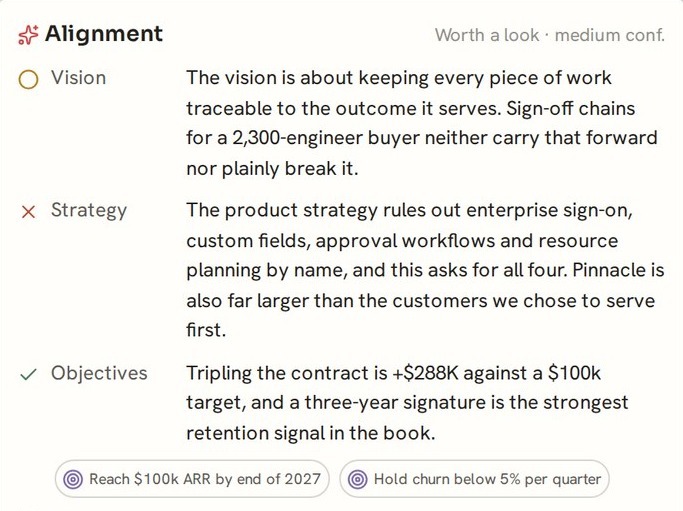
- When an Insight or an Opportunity lands, an agent reads your full strategic stack: Vision, Strategies, Objectives, and the Insights your team has captured. It flags conflicts, surfaces prior decisions, and proposes work your evidence already supports. It shows up at the decision moment with the context loaded. AI challenges and recommends. You make the call.
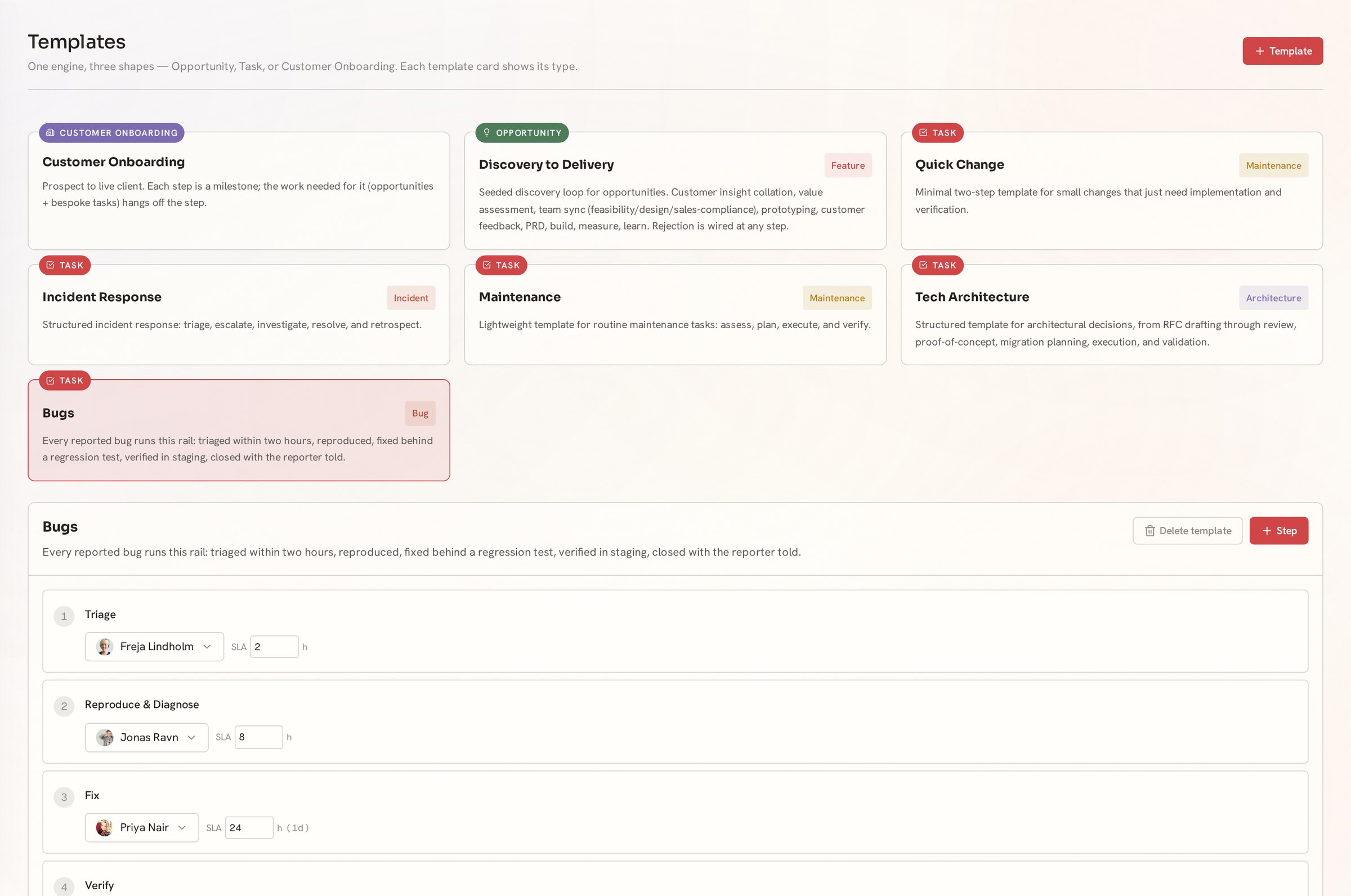
Templates with constrained flexibility. Opinionated on ownership, flexible on shape.
- Problem
- Most PM tools quietly run on a power user. Every team works differently, so the tool is built flexible, and one person wrestles that flexibility into a convention and pushes it top down. They remember it. The team doesn't, because the tool lets you do whatever you want, and new hires spend a month decoding 'how we actually operate' from Slack threads. Going rigid is no answer either: a tool that forces convergence gets abandoned for a Notion doc, and free-form boards turn into voids where specs sit in 'In Progress' for weeks because nobody owns the next step.
- Solution
- Telos is opinionated where it matters and flexible where it doesn't. You define the shape (capture, triage, solutions design, delivery, measure, whatever your team actually does), and where a step has a clock on it, the SLA that governs it. Telos enforces the one thing that breaks without structure: every step has a named owner. The template is the operating manual. Once it's set, everybody works the same way, and that's the feature. Open Telos on day one and a new hire knows who owns what, when.
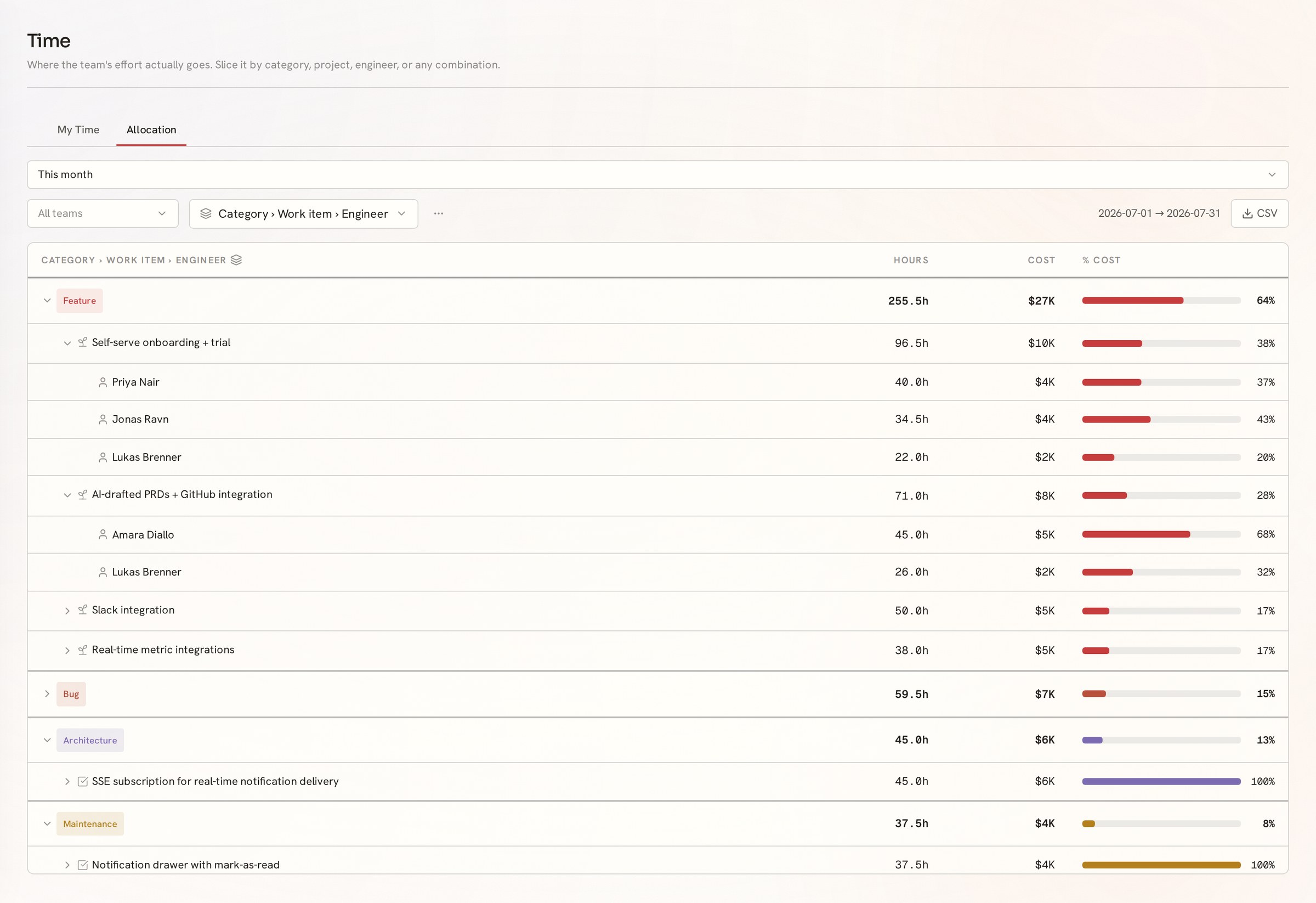
Where the money actually went. For the executive at the top.
- Problem
- Executives need a clean answer: 'what did we actually fund this quarter — features, bug fixes, maintenance, or architecture?' Today that answer comes from someone exporting four tools, burning a bunch of tokens or joining the data in a spreadsheet.
- Solution
- Telos categorizes every Opportunity and Task by template type and rolls engineer-hours into a live time-allocation breakdown. Open the dashboard, see the split by category, by work item, by engineer, in hours and in cost. Drill into any slice. Compare quarters. The executive overview lives in the same tool the engineers use, and it's never more than one click stale.
Reprioritize and see the blast radius. Every committed date it touches, before you commit.
- Problem
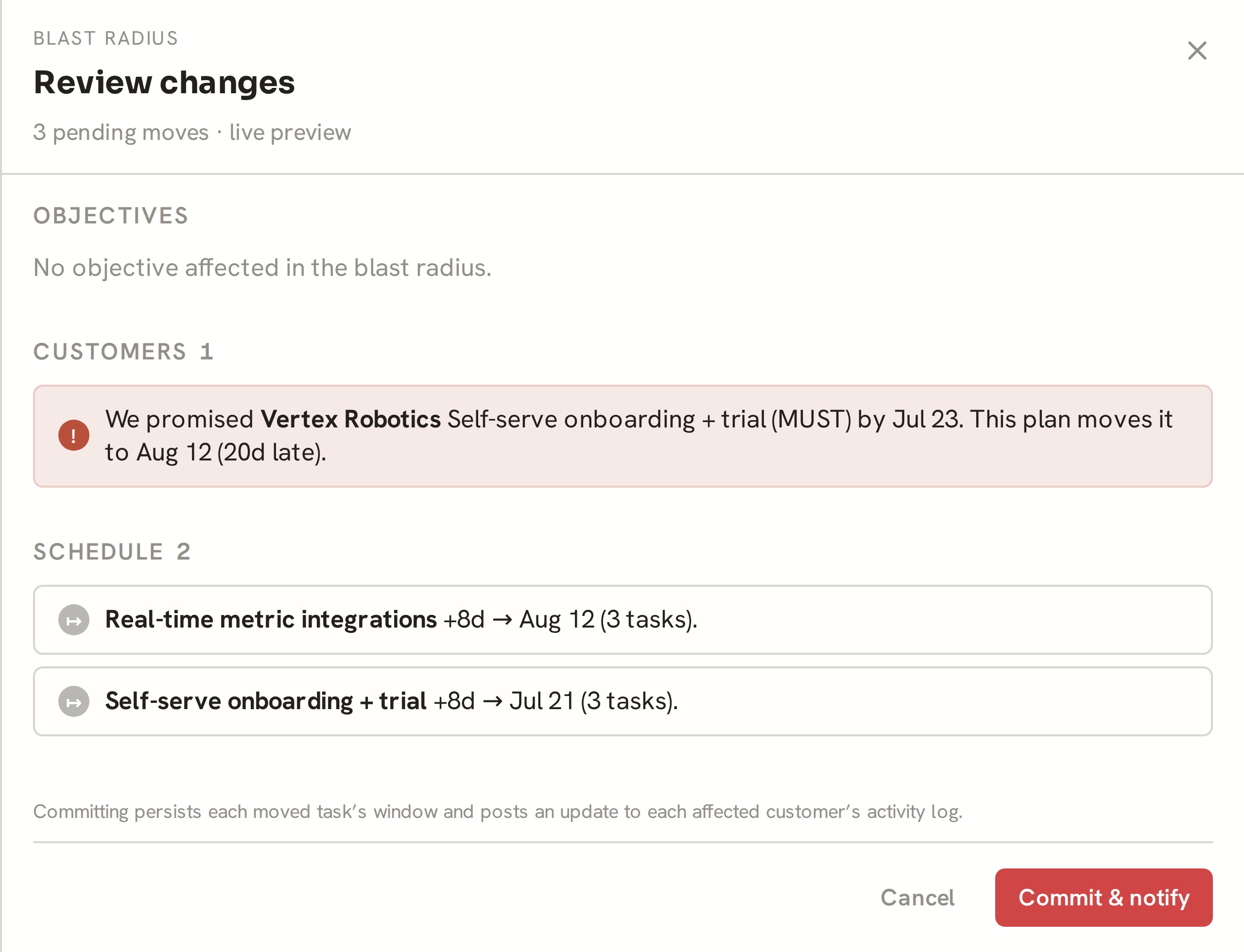
- Replanning happens in a vacuum. A customer escalates, you pull the team onto it, you drag the roadmap two weeks. What you can't see is what just broke: the date you promised another customer, the objective that now slips a quarter, the three tasks waiting on the one you moved. The cost surfaces weeks later in an angry email or a missed target, long after the decision was cheap to undo.
- Solution
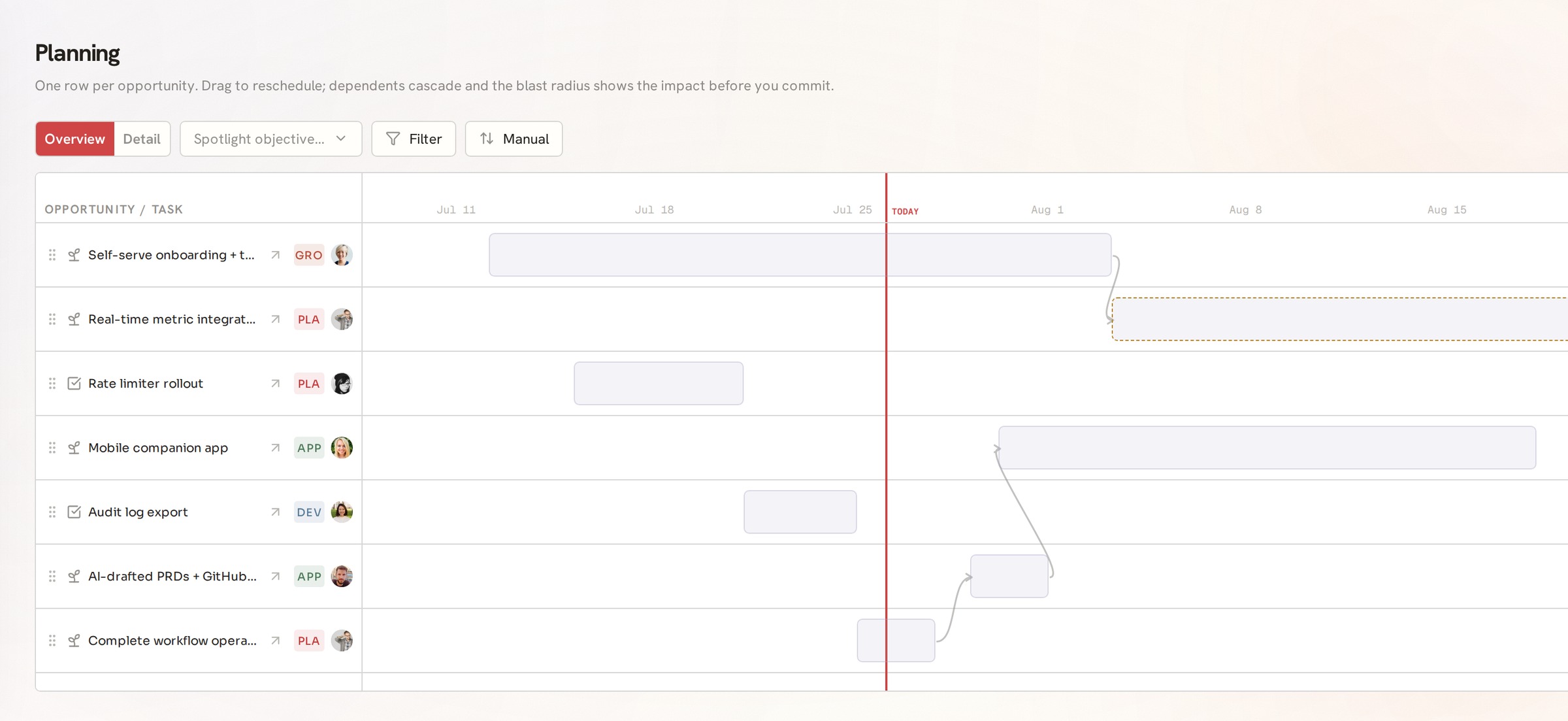
- Drag any bar on the planning timeline and the blast radius surfaces before you commit: dependents cascade, slipping objectives show the new date and how late, and every breached customer commitment names the account and the days lost. Commit anyway if it's the right call, and the change posts to that customer's page, so the success manager hears it from Telos, not from a blindsided customer. Eyes open when you make a commitment, and when planning moves it.
te·los
/ˈtɛlɒs/ noun
The ultimate purpose, end goal, or final objective of an activity, system, or object.
Every opportunity and every task should be able to name its telos.